
 Literature Guides
The Grapes of Wrath Guide
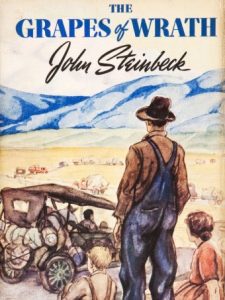
Written by John Steinbeck, The Grapes of Wrath is set in the Depression-era Oklahoma Dust Bowl and follows the story of Tom Joad and his family as they embark on a journey to California to find work, a new home and a more promising future. Regarded as the masterpiece of Steinbeck’s literary collection, and possibly one of the best books of all time, The Grapes of Wrath is nothing short of exceptional, highlighting the power of mankind’s love and unity and desire to bond together in the most difficult times.
Author: John Steinbeck
Type of Literary Work: Novel
Genre: Historical Fiction
Initial Publishing Year: 1939
Setting: Oklahoma, Depression-Era
Primary Characters: Tom Joad, Ma Joad, Jim Casey, Rose of Sharon Joad, Pa Joad
Themes: Love, Unity, Strength, Re-Birth, Survival
Symbolism: Vacant Houses, Turtle crossing the road, Ma Joad, truck
The three most prevalent elements of The Grapes of Wrath:
- The Grapes of Wrath is set during the Depression-Era in the Oklahoma Dust Bowl; a name given to the area after long periods of high winds and drought consumed most of the Midwest – including the state of Oklahoma. As a result of these less than favorable conditions, and the financial stress caused by the Stock Market Crash, much of the population of America’s lower Midwest elects to go off in search of a better life.
- The Grapes of Wrath’s leading character is a man by the name of Tom Joad. Tom, despite multiple acts of violence and a life as a fugitive, is regarded as the hero of the novel.
- The most noteworthy image in the novel is when Rose of Sharon Joad, who, having recently birthed a stillborn baby, breastfeeds a sickly gentleman on a dirty barn floor.
The Grapes of Wrath is considered a must read.
Summary
In the throes of the Great Depression, Tom Joad hitchhikes through Oklahoma after having recently been paroled from the local penitentiary. During his travels he meets Jim Casy. Tom remembers the man from his childhood, he was a preacher. However, as Jim explains to Tom, that while he is still a God-fearing man, he no longer feels a divine calling and has renounced priesthood. Tom offers for Jim to join him on his journey home. Jim accepts.
As the men arrive at the Joad farm, they are shocked to find it abandoned. A neighbour, Muley Graves, approaches the men and proclaims to Tom that the bank had been there earlier and had escorted the family off of the land. They had been staying with a relative and had plans to make the voyage to California in search of employment. Tom and Jim wait out the night at the now shuttered farm and venture to meet up with Tom’s family the next morning.
Tom arrives at the home of his Uncle and finds his family preparing to set off. Jim asks if it might be appropriate for him to join the Joad family on their trek, and they agree without hesitation. As soon as they have sold the last of their belongings and are ready to go – all except for a reluctant Grandpa who would much rather stay on his land than embark on a long journey West. Knowing that they are unable to leave their aging patriarch behind, the family drugs the old man and loads him into the truck.
As their journey starts out, the Joad’s come upon a young migrant couple – the Wilsons – whose car has broken down, but offer their tent to Grandpa who soon after succumbs to a stroke. Tom and Al help to repair the Wilson’s car and both families commit to finishing the remainder of the trip together.
As the families arrive in New Mexico, the car being driven by the Wilson family breaks down once more, forcing the group to stop. It is noted that Grandma’s health has taken a serious turn for the worst since the death of Grandpa, and Tom insists that the others should take the truck and go on without them. However, Ma refuses. She insists that the family must stay together. When they finally reach the California borderline, Sairy Wilson falls desperately ill and is unable to go any further. The families decide to separate and the Joads’ set off to cross the unforgiving California desert.
With the health of Grandma becoming increasingly concerning, Ma questions whether or not she will be able to withstand the trip across the desert. Yet, being unable to stop, Ma chooses to stay in the back of the truck with Grandma and consoles her as she silently passes away. As dawn arrives, the Joad family has reached the end of the desert and entered Bakersfield valley. Ma informs the rest of Grandma’s passing and insists that they give her a proper burial.
The family settles down for the night at the first camp they come upon, a shanty of tents and shelters and the men strike up a conversation with Floyd Knowles. The group is approached by a policeman and a businessman who offers them employment. Floyd requests a written wage offer and is accused by the policeman of being a ‘red’. As the policeman is trying to arrest Floyd, Tom trips him and Jim kicks him – rendering him unconscious. When the officer comes to, Jim turns himself in in order to divert attention from Tom who needs to continue on with his family.
As the Joad family continues to travel south, they find a government-run camp in Weedpatch, where they stay for just over a month but realize they must continue on.
Soon they are offered a job in Tulare, picking peaches. The gates of the camp are blocked by a large group of men waving and shouting. The family receives an escort from the state police and get to work. However, the payment of five cents per box of peaches picked is hardly enough to keep the family fed. After finishing his first day, Tom travels outside of the ranch and runs into Jim who is spearheading a strike against the farms owners – the workers are outraged at the orchard owners for wanting to pay just two and a half cents for every box of peaches picked.
Tom then realizes that he is only receiving five cents per box because he is working as a ‘scab’. While Tom and Jim talk, authorities sneak up and clobber Jim on the head, presuming that he is the leader of the strike. Jim is killed instantly. In a fit of rage, Tom begins to beat the assailant and ends up with a broken nose. Tom is able to flee, and hides in the orchard until he can safely reach his family.
Tom has become a fugitive, easily recognizable by his broken nose and scarred face. The family decides to leave the ranch as soon as the sun rises. They soon find employment picking cotton and take up residence in an empty boxcar with the Wainright family. Still fearing the authorities, Tom continues to hide and his mother leaves food for him. The Joad’s are comfortable and fed, however, soon Ruthie gets into an altercation with another child and threatens to contact her big brother, Tom, who has been hiding because he killed two men. This prompts Ma to instruct Tom to flee. Tom agrees and sets off to continue on the social good that Jim had started.
Eventually, Al Joad proposes to sixteen year old Agnes Wainwright. When the cotton season comes to an end, the rainy season begins. It rains long and hard, and the water levels rise steadily. Rose of Sharon goes into labor as the boxcar is on the verge of flooding. Pa, Uncle John, Al and the other men endeavor to contain the river by building an embankment, however, find their efforts pointless. The baby of Rose of Sharon is still born.
Several days later, the rain finally stops. Everyone, with the exception of Al and the Wainwright family, leave the boxcar in search of higher ground. The family ventures upon an old barn, currently inhabited by a young boy and his ailing father. The boy tells the family that his father is near starved to death and has not eaten in six days. His father, he says, struggles to keep down solid food. Rose of Sharon recognizes the horrible fate that awaits the man if he does not soon eat and offers him her breastmilk. The boy and the rest of the family exit the barn as she nourishes the dying man from her breast, while they lay on the dirty barn floor.


The Structure of the Novel
From its original publication date, the unusual way The Grapes of Wrath was structured has been questioned by many of those who have read the novel in its entirety. The author uses an unconventional method of interjecting chapters of random information – or commentary – between narrative chapters and this jumbling of information is found by many readers to be distracting and said to take away from the realness of the life and story of the Joads.
These ‘intercalary’ chapters serve a very specific purpose in terms of expanding upon important events and providing commentary that supports what happens in the narrative proper. The Grapes of Wrath has sixteen intercalary chapters. Despite the fact that the Joad family does not appear in any of the intercalary chapters, much of the events described in each of those chapters foreshadow the experiences of the Joads. Interestingly, these intercalary chapters are needed to provide readers with a very generalizes synopsis of the social conditions that affect the main characters, as well as to deliver historical accuracy and commentary on the social and political background of the novel.
The author regularly utilizes symbolism, motifs and narrative to bridge the connection between each intercalary chapter and its accompanying narrative chapter. For example, the land turtle, as described in Chapter 3, will be found by Tom in Chapter 4. And, the monologue of the used car salesman occurs immediately prior to the purchase of the truck that the Joad’s will use to make their journey. Furthermore, the Joads’ continued search for employment in California is heralded by the State’s strong history of migrant labor.
Steinbeck understood how imperative it was for his readers to grasp the true social message delivered by his novel. He wanted them to understand the struggle of the travelling families, and how desperately they were oppressed by the larger and more powerful forces in a social crisis.
He feared that those reading The Grapes of Wrath would not clearly comprehend these issues unless they could truly be sympathetic to the ordeals of the Joad family. On the other hand, he did not want his audience to view these events as an isolated problem, specific only to the Joads. By using intercalary chapters, Steinbeck was able to create balance by tying together precise social facts and narrative elements to craft a uniquely personal story that also told a very emotional tale about universal truths and the so-called human condition.
The Social Philosophy of The Grapes of Wrath
The social philosophy experienced in the novel is touted as being both complex and contradictory. Jim Casy expresses a social theory that is later acted on by Ma and eventually adopted by Tom. This social theory calls upon the ‘little people’, the disadvantaged and the poor, to band together to stand up to the capitalist business owners. This philosophy declares that, in order to survive, mankind must band together and strive for unity. This theory is elaborated in The Grapes of Wrath in the education level of those who are oppressed, the organization of unions and the use of strikes and protests as a way to demand change and fairness.
Speaking theoretically, the author’s philosophy is based on socialist theory, despite the obvious influence of several American philosophies. The salt-of-the-earth language of Jim Casy, and his belief that every individual soul is just a smaller piece of one giant soul, is an akin to the Emersonian concept of the Oversoul. The symbolism that exists between the fruitfulness of the land, and the lifelessness of machinery speaks to the Jeffersonian agrarianism theory, which states that the identification of mankind with soil is required for life to continue. Lastly, Jim’s statement, “maybe it’s all men an’ all women we love,’ illustrates the concept of humanism – a love for all people and the ability to embrace democracy.
Character Analysis
Tom Joad
It is widely believed that Jim Casy embodies the authors true philosophical belief system, and that Tom Joad is flawed and completely human. As the novel’s primary character, Tom has the most character development, and goes through what is known as an ‘education of the heart.’ This learning, experience, foresight, and the teaching of Jim Casy speak of the moralistic journey man experiences between himself and his community – when he learns to care not only for himself, but also for those around him, and the world he lives in.
Tom is a kind man, however, he has a short temper and is often vengeful. Despite this, he is a man of action and the hero of the book. He embodies pragmatism, and unlike Jim Casy (who largely observes and speaks about the human condition) Tom’s actions are more subconscious and intuitive.
Tom is more concerned with the here and now, not the moral circumstances of his actions.
Ma Joad
Ma, since the first chapter, has proven herself to be the backbone of the family. Her chief objective has always been to care for her family, to make sure that they are fed, comfortable and safe. She believes that her family will experience any fear or pain that she experiences, so she does everything in her power to stifle these emotions in herself.
She feels that it is her duty to build up her family, and to help them to find joy in dark moments. Her strength is what truly binds the family together and, despite the fact that her family is her main concern, she never shies away from the opportunity to help a stranger.
Jim Casy
Jim is a traveling former preacher who struggles to come to terms with his personal beliefs as they relate to God, sin and a holy life. In the beginning of the book, Casy starts to adopt Emerson’s theory of the “Oversoul’”– the belief that all individual souls are just a small part of one giant soul. He states, “There ain’t no sin, and there ain’t no virtue. There’s just stuff that people do. It’s all part of the same thing.’ Jim shares his beliefs with Tom, who will impatient, is willing to listen. The teaching of Jim Casy widely reflect various theories of pragmatism, socialism, humanism and transcendentalism.
Jim Casy is regarded as the novel’s moral spokesman and touted as being ‘Christ-like’. In fact, his initials J.C., are identical to the initials of Jesus Christ, and similar to Christ, Jim Casy sacrifices himself in place of others when he turns himself in to the policeman in order to save Tom. Through this sacrifice, Jim lands in jail where he first learns about organization and later, after his release, organizes a strike to protest unfair treatment at a peach orchard.
Rose of Sharon
Rose of Sharon is easily one of the least likeable characters in the Grapes of Wrath. She is self-centered and expects to be catered to. She and her new husband spend the duration of the family’s trek to California daydreaming about what their life will be like. She is pregnant and constantly concerned that every event is somehow related to the child in her womb.
Despite an attempt by her mother to intervene, Rose of Sharon begins to wallow in self-pity and life grows harder for the Joad family. When Rose of Sharon’s child is stillborn, she experiences a tremendous change of character. She offers the breastmilk that will never be fed to her child to a man she finds nearly starved to death in the book’s ending.
Pa Joad
Not as formative of a character as Ma, Pa exists to represent the theme of the loss of human dignity. When the Joad family farm is lost to the bank, and the older Joad is unable to provide for his family, he appears bewildered and lost. Initially, Pa is regarded as the head of the family, and is respected as such.
However, as time progresses, he beings to relinquish his responsibilities to Tom or Ma. Feeling that he is no longer capable of providing financially for his family, Pa grows angry and begins to shut himself off from the world. In Tom’s narratives, readers begin to understand what Pa might have been like as he was being taken away from him land – strong, independent, and capable of a murderous rage when bullied.
Important Quotes from the Grapes of Wrath
“I got thinkin’ how we was holy when we was one thing, an’ mankin’ was holy when it was one thing. An’ it on’y got unholy when one mis’able little fella got the bit in his teeth an’ run off his own way, kickin’ an’draggin’ an’ fightin’. Fella like that bust the holi-ness. But when they’re all workin’ together, not one fella for another fella, but one fella kind of harnessed to the whole shebang.”
Read in chapter 8, when Tom Joad and Jim Casy arrive to Uncle John’s farm after the Joad’s ask Casy to say grace. While hesitant, these are the words spoken by Jim. They speak largely to the philosophy that governs the entire novel. Both Casy and Tom put these words into practice as they fight for the rights of the oppressed and less fortunate.
“The last clear definite function of man – muscles aching to work, minds aching to create beyond the single need – this is man. To build a wall, to build a house, a dam, and in the wall and house and dam to put something of Manself, and to Manself take back something of the wall, the house the dam; to take hard muscles from the lifting, to take the clear lines and form from conceiving. For man, unlike any other thing organic or inorganic in the universe, grows beyond his work, walks up the stairs of his concepts, emerges ahead of his accomplishments.”
This quote exemplifies the lofty tone found in the intercalary chapters used to build up the story of the Joads. It adopts a near biblical tenor and showcases moral simplicity – man toils, and because of his labor, evolves as a person.
Key Facts
Major Conflict
During the depression-era, a drought forces farmers to travel to California in search of work. This causes a rift between property owners and migrant workers. The story of Tom Joad depicts that conflict between ‘I’ and “We” and the struggle to put the needs of others over the safety of one’s self.
Rising Action
Upon his release from prison, Tom resolves to keep to himself. However, after meeting Jim Casy, he finds himself drawn to the path of the holiness of human beings and the workers’ movement.
Climax
Jim Casy is murdered by a policeman, Tom murders the policeman in revenge and becomes a fugitive. He then devotes himself to continuing Jim’s cause to champion better working conditions.
Falling Action
Tom explaining to Ma the teachings of Jim Casy; Tom leaving his family to continue Jim’s work; Rose of Sharon nursing the dying man.
Theme
The inhumanity that man extends to other man; Wrath meaning; The saving grace of family and spiritual belief; The true effect of selfishness and philanthropy.