
A Research Guide - Home
Google


Chapter 10. Works Cited, References, and Bibliography - What's the Difference?

Home


Site Map

Privacy
Search
Contact

eNotes


Your Ad Here


Links to related pages:

How to Write Footnotes and Endnotes in MLA Style
Footnotes and Endnotes - Examples in MLA Style
How to Write Parenthetical References - Examples in MLA Style
Works Cited, References, and Bibliography - What's the Difference?
Guidelines on How to Write a Bibliography in MLA Style
How to Write a Bibliography - Examples in MLA Style
Quoting Passages Using MLA Style
Footnotes in MLA Style - Sample Page
Endnotes in MLA Style - Sample Page
Parenthetical References in MLA Style - Sample Page
Works Cited in MLA Style - Sample Page
Research, Writing, and Style Guides (MLA, APA, Chicago/Turabian, Harvard, CGOS, CBE)

For a detailed treatment on citing sources using MLA style with many more examples, please use the official MLA Handbook:
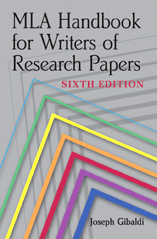
MLA Handbook 6th ed.

All information relating to MLA style as presented in this Web site has been based on this authoritative publication from the Modern Language Association of America.

Gibaldi, Joseph. MLA Handbook. 6th ed. New York: MLA, 2003.

Works Cited is sometimes referred to as References. The terms mean the same thing. Each is an alphabetical list of works cited, or works to which you have made reference. Works Cited is generally used when citing sources using MLA (Modern Language Association) style, while the title References is used when citing sources using APA (American Psychological Association) style.

Works Cited and Bibliography are not the same. In Works Cited you only list items you have actually cited. In a Bibliography you list all of the material you have consulted in preparing your essay whether or not you have actually cited the work.

Entries in Works Cited, References, or Bibliography are put in alphabetical order by last names of authors, editors, translators, etc. or by first words of titles.

If the first word of the title is "The", "A", or "An", and the word is being used as an article, e.g., in the title: The Little Book of Irish Clans, the entry is placed under "Little" and the article "The" is ignored. In the title: A Is for Apple, however, the entry is placed under A since A is used as a noun and not as an article in this case.

Sometimes the article "The" is used as part of the name of a company or magazine or journal for emphasis, e.g., The Champ, or The Sports Network. For Internet sites, use the URL as a guide. If "theyellowpages" is used in the URL, treat "The" as part of the title, and list "The Yellow Pages" alphabetically under "The". If "edge" and not "theedge" is used in the URL, list the magazine title "The Edge" under "Edge" and treat "The" as an article and ignore it.

Where appropriate, a cross reference may be used to direct readers to the proper location, e.g. Yellow Pages, The See The Yellow Pages.

Remember:

1. DO NOT number entries.

2. DO NOT list citations separately by categories. All references are placed in ONE ALPHABETICAL LIST by first words of citations, regardless of where citations come from.

3. Begin on a new page. Start on the 6th line from the top (or 1" down from the top of the paper), center, and type one of the following titles: Works Cited, References, or Bibliography. Double space after the title. List all entries in alphabetical order by the first word, taking into consideration the rules governing titles that begin with articles.

4. Begin the first line of each entry flush at the left margin. Keep typing until you run out of room at the end of the line. Indent 5 spaces for second and subsequent lines of the same entry. Double-space all lines, both within and between entries. Remember that this is only a guideline adapted from the MLA Handbook. You are advised to follow the style preferred by your instructor.


Works Cited, References, or Bibliography Sample Page:


Works Cited

Adams, Paul. "Furious Arafat Is Freed." Globe and Mail [Toronto] 2 May

          2002: A1+.

"Beginner Tip: Presenting Your Page with Style." Webmaster Tips Newsletter.

  July 2000. NetMechanic. 13 Sept. 2004 <http://www.netmechanic.com/

          news/vol3/beginner_no7.htm>.

Collins, Ronald K.L., and David M. Skover. The Trials of Lenny Bruce: The

          Fall and Rise of an American Icon. Naperville, IL: Sourcebooks, 2002.

Continelli, Louise. "A Place for Owls to Heal." Buffalo News 12 Jan. 2003: C2.

"E-Money Slips Quietly into Oblivion." Nikkei Weekly [Tokyo] 22 Jan. 2001: 4.

Gordin, Michael D. "The Science of Vodka." Letter. New Yorker 13 Jan. 2003: 7.

"Ho Chi Minh."  Encyclopaedia Britannica. 2004. Britannica.com.
 
          15 Sept. 2004 <http://www.britannica.com>.

King, Stephen. Black House. New York: Random, 2001.

---. From a Buick 8: A Novel. New York: Simon & Schuster, 2002.

Law and Order. Prod. Wolf Film in assoc. with Universal Television. NBC Television

Network. WHEC, Rochester, NY. 13 Mar. 2003.

Longin, Hellmut. Telephone interview. 11 Jan. 2006.

Marshall, Leon. "Mandela in Retirement: Peacemaker without Rest." National

          Geographic.com. 9 Feb. 2001. 13 Mar. 2003 <http://news.nationalgeographic.com/

          news/2001/02/0209_mandela.html>.

Microsoft PowerPoint Version 2002 Step by Step. CD-ROM. Redmond, WA: Microsoft, 2001.

Mitchell, Joni. Both Sides Now. CD. Reprise Records, Time Warner.

Dist. Warner Music Canada, Scarborough, ON, 2000.

"Mug." Def. 2. The New Lexicon Webster's Encyclopedic Dictionary of the English

Language. Canadian ed. 1988.

NASONEX Nasal Spray, Schering. Advertisement. Newsweek. 9 Sept. 2002: 9.

"Nazi Party". New Encyclopaedia Britannica. 1997 ed.

The Nutcracker. By Pyotr Ilyich Tchaikovsky. Chor. and Libretto James

Kudelka. Cond. Ormsby Wilkins and Uri Mayer. National Ballet of

Canada. Hummingbird Centre, Toronto. 30 Dec. 1999.

O'Keefe, Mark. "Definition of 'Rich' Is Elusive." Detroit Free Press 12 Jan. 2003:

          1E+.

Penny, Nicholas B. "Sculpture, The History of Western." New Encyclopaedia

Britannica. 1998 ed.

PicoSearch. "Your PicoSearch Account is Reindexed." E-mail to I. Lee. 2 Feb. 2005.

Pulda, Arnold. "Handling Hate Sites." Classroom Connect Newsletter May 2003: 18-19.

Rai, Arti K., and Rebecca S. Eisenberg. "Bayh-Dole Reform and the Progress of

          Biomedicine." American Scientist Jan.-Feb. 2003: 52-59.

RAMeSize. Vers. 1.04. 15K. 24 Sept. 2000. Blue Dice Software. 13 Mar. 2003

<http://www.pcworld.com/downloads/file_download.asp?fid=7605>.

Classroom Connect -- Library Hot Five. "Library Hot Five #241: Online Magazines for Kids."

E-mail to HOT5@LISTSERV.CLASSROOM.COM. 17 Sept. 2004.

Great Wall of China, Beijing, China. Personal photograph by B. Davenport. 28 Dec. 1996.

Schubach, Erik. "Bugs Bunny." Cartoon. Cartoon World! 1998. 12 Oct. 2001

<http://www.cet.com/~rascal/graphics/bugsbun.gif>.

Svitil, Kathy A. "Can I Pour You a Pint of Light?" Discover Nov. 2002: 12.

---. "The 50 Most Important Women in Science." Discover Nov. 2002: 52-57.

"Thanks a Bunch!" Electronic card. Blue Mountain Arts. 2000. Kersten Brothers

Studios. 13 Mar. 2003 <http://www1.bluemountain.com/eng3/kersten/TUbunch.html>.

The Tuxedo. Dir. Kevin Donovan. Prod. John H. Williams, and Adam Schroeder,

Perf. Jackie Chan and Jennifer Love Hewitt. DreamWorks, 2002.

"What is Dry Eye?" TheraTears. Advertisement. 2003. 15 May 2003

          <http://www.theratears.com>.

Wolanski, Eric, et al. "Mud, Marine Snow and Coral Reefs." American Scientist Jan.-Feb.

          2003: 44-51.

HOME         PREVIOUS         NEXT